

I have just spotted an item up for auction on Ebay described as a steam boiler made by Gower of Bedford which has brought back some memories of my distant past.
Back in the 60’s I was employed for a while repairing plant machinery with a construction company – Lindum Lincoln. We had a request to attend a sick JCB digger which had been digging up the road in Bedford. When we arrived we found the “eye” on the end of one of the main hydraulic rams had broken away. Alf Richardson the welder (and landlord of The Swan pub at Astwood) who was with me remarked that he felt unable to repair the thing but knew a man that would.
Busted ram duly stowed in the back of our van, Alf drove us both to the ram repairer whose yard turned out to be between the new County Hall (or Black Diamond corner as it was then) and St. Johns railway station..
We pulled up outside a corrugated iron fenced compound in which I could see all sorts of archaic machinery, old tractors, steam engines, boilers et al. Going to the back doors of the van to pull out the ram Alf warned me “ Whatever you do, don’t swear, or we’ll be chucked of the premises”. Turns out that the proprietors were very, very religious. It also turned out that they were very skilled at engineering repairs that other business’s shied away from.
We were greeted by two men dressed mostly in leather with leather scull caps in a workshop that was straight out of the 17th century. Hard packed earth floor and machinery driven by lay shafts.
They took the ailing patient from us and two hours later we picked it up, healed, welded and whole again.
I had met the Gower brothers. They don't make 'em like that any more!!
Tuesday, 17 April 2012

Thursday, 15 March 2012
150312
I needed to find a way to touch up my carbide lathe tools. I worked as a tool and cutter grinder for a while (in another life many years ago) so I knew that using a green grit wheel would not give me the best results. So, I bought an 80mm diameter diamond cup wheel from fleabay and lashed up a grinder around it.
I was not overly concerned at how it should look so long as it would do the job. I have uploaded a short film clip to YouTube and if anybody is interested you can find it here:
http://www.youtube.com/watch?v=SqosVzhWtkA&feature=channel
The base is a bit of my son’s old bookcase, motor from car boot sale – couple of quid. All of the chunky aluminium hacked from a large jig, 50p – car boot again! Guard is a bit of our old milk saucepan and the grinding spindle is a stainless steel door handle running in two new ball races – both from the boot again and costing pence.
The drive belt hurt. I had to have it made up and they stung me for £13.66. Not to worry though, I have ended up with a very handy device which does a “proper job”.
Incidentally, the clamp holding the tool in the film has been in my possession for some time now (I’m sure you can guess where it came from) but I have never known what its original purpose was but I DO know what a previous owner has been using it for – how do I know?
After I had shot the footage I was sitting at my desk turning the clamp over in my hands and for the first time, I noticed it was rattling slightly. I was puzzled as there was nothing visible that could rattle. And why would the manufacturer machine a groove around the handle like that? I grasped the handle and twisted the end and surprise, surprise it started to turn and unscrew.
The handle was hollow and the mystery rattling things fell out of their hiding place and onto my desk. Three small pieces of shaped steel each of which could be gripped in the jaws of the clamp. I know a lock pickers kit when I see one and that is what I was looking at here………………

I was not overly concerned at how it should look so long as it would do the job. I have uploaded a short film clip to YouTube and if anybody is interested you can find it here:
http://www.youtube.com/watch?v=SqosVzhWtkA&feature=channel
The base is a bit of my son’s old bookcase, motor from car boot sale – couple of quid. All of the chunky aluminium hacked from a large jig, 50p – car boot again! Guard is a bit of our old milk saucepan and the grinding spindle is a stainless steel door handle running in two new ball races – both from the boot again and costing pence.
The drive belt hurt. I had to have it made up and they stung me for £13.66. Not to worry though, I have ended up with a very handy device which does a “proper job”.
Incidentally, the clamp holding the tool in the film has been in my possession for some time now (I’m sure you can guess where it came from) but I have never known what its original purpose was but I DO know what a previous owner has been using it for – how do I know?
After I had shot the footage I was sitting at my desk turning the clamp over in my hands and for the first time, I noticed it was rattling slightly. I was puzzled as there was nothing visible that could rattle. And why would the manufacturer machine a groove around the handle like that? I grasped the handle and twisted the end and surprise, surprise it started to turn and unscrew.
The handle was hollow and the mystery rattling things fell out of their hiding place and onto my desk. Three small pieces of shaped steel each of which could be gripped in the jaws of the clamp. I know a lock pickers kit when I see one and that is what I was looking at here………………

Sunday, 9 October 2011
091011
I have not blogged a blog for a while yet and felt that I should take up a pen and write. Having recently become an old aged pensioner I feel that I should have the spare time to make these entries more regularly – maybe I will.
Neither of us had ever visited Bath in the UK so in mid August – of we went. We stayed at a lovely hotel (Paradise House) and soaked up the atmos. A visit to the roman baths was the highlight of our stay but all in all, Bath was beautiful.
We left Bath after a few days and meandered south to the caravan at Bowleaze Cove where we spent the next month or so taking our ease.
We are back at home for the moment. L is sorting out on the domestic side and I am getting my model engineering shed organized – just not enough minutes in the day to do what I want!
A week or so more and we will head south again to enjoy Dorset and shut down the caravan for winter.
I’ll post some of the pics taken during the year over the coming weeks.
Neither of us had ever visited Bath in the UK so in mid August – of we went. We stayed at a lovely hotel (Paradise House) and soaked up the atmos. A visit to the roman baths was the highlight of our stay but all in all, Bath was beautiful.
We left Bath after a few days and meandered south to the caravan at Bowleaze Cove where we spent the next month or so taking our ease.
We are back at home for the moment. L is sorting out on the domestic side and I am getting my model engineering shed organized – just not enough minutes in the day to do what I want!
A week or so more and we will head south again to enjoy Dorset and shut down the caravan for winter.
I’ll post some of the pics taken during the year over the coming weeks.
Wednesday, 17 August 2011
Scratch built steam engine.

This is a scratch built steam engine that I completed 30 years ago. The design originated from a set of plans published by Model Engineer. If my memory serves me right it was described as a marine engine but I would class it more as a mill or factory engine. I made several modifications to the design but the major departure from the original was a doubling of all dimensions on the drawing. (and yes, it did cause problems.)
For the most part the machining and construction was carried out on my ancient leather belt drive Grayson three and a half inch lathe, (sadly missed). Milling was done using a vertical slide on the lathe. My drill press was machined from a set of castings and my bench grinder was hand made and powered by a washing machine motor.
No castings were used in the construction. With a few exceptions – nuts and washers for instance – everything was hacked from solid bar even the cast iron parts were cut from fine grained cast bar.
On completion, I ran it up briefly down the local pub on CO2 gas just to check the timing. It hasn’t been run since and for most of that time has lived in a toolbox wrapped in oily rag. Even so it had become very dirty in that time and rust was starting to show so a couple of days ago I set to and gave it a clean as best I could without dismantling it. The sump within the frames has a layer of brown crud that has set like varnish sealing in the dead critters and Christmas tree needles???? – don’t ask, I can’t remember!
I recently acquired an air compressor so I was looking forward to seeing my little engine in action again. I filmed it running and you can see the results here – just click on the link:
http://www.youtube.com/watch?v=1z224x7FYXM&feature=youtube_gdata
Technical detail:
• Bed or frame constructed from gauge plate dowelled and screwed with edge radii stone dressed by hand.
• Phosphor bronze double acting D valved cylinder with 1” dia cast iron piston.
• Piston “ring” and stuffing box glands fitted with traditional graphite cording.
• Cylinder lagging cover from shim stock – oiled and heated to produce blue “parkerizing” effect.
• Connecting rod partly machined then filed, stoned and emeried to a finish.
• 3.5 inch dia cast iron flywheel turned from a 4” dia bar.
• Runs (slowly but nicely) on just 10 psi
• Overall length approx. 12.5” or 32cm if you’re under 65
• Weighs in at 18lbs or just over 8 kg
Monday, 27 June 2011
270611
We went to the “tankfest” at Bovington tank museum yesterday and watched some historic armoured stuff rumbling round the arena. At eighty tons this behemoth nicked named “the tortoise”, is the heaviest tank ever built.
![]()
Behind us sat an elderly man in a wheelchair. He was receiving quite a lot of attention so I asked a chap why and was told that Joe Ekins – his name – famously destroyed three German tanks in a single morning during WW2. He is regarded as a living legend.
Nice to see the scarlet coats of a group of Chelsea Pensioners at an occasion like this. I overheard a conversation between two blokes who were referring to one of these great characters “Where’s Alf ?” one asked – “he’s in the beer tent getting as much free ale down him as he can manage!” . Good for you old boy I thought, you deserve it.
![]()
Picked up a nice framed and glazed colour print of an engraving at Dorchester boot on Sunday. The border is annotated in pencil “Weymouth Bay engraved by J. Bluck from a J.W.Upham original – 1821”. If you know Weymouth you may wonder where the Nothe Fort has gone to. Well, it wasn’t completed until the 1870’s – quite a long time after this was painted. The picture is much nicer than my scan but yer’tis anyway.
![]()
I have just done a little googling on the artist and engraver and found that a gallery in London are offering similar plates for around £300. Investing in the purchase of this picture in the sum of one quid has left me with a deep feeling of contentment. In fact, the phrase"dog with two willies" springs to mind. Oh happy day.

Behind us sat an elderly man in a wheelchair. He was receiving quite a lot of attention so I asked a chap why and was told that Joe Ekins – his name – famously destroyed three German tanks in a single morning during WW2. He is regarded as a living legend.
Nice to see the scarlet coats of a group of Chelsea Pensioners at an occasion like this. I overheard a conversation between two blokes who were referring to one of these great characters “Where’s Alf ?” one asked – “he’s in the beer tent getting as much free ale down him as he can manage!” . Good for you old boy I thought, you deserve it.

Picked up a nice framed and glazed colour print of an engraving at Dorchester boot on Sunday. The border is annotated in pencil “Weymouth Bay engraved by J. Bluck from a J.W.Upham original – 1821”. If you know Weymouth you may wonder where the Nothe Fort has gone to. Well, it wasn’t completed until the 1870’s – quite a long time after this was painted. The picture is much nicer than my scan but yer’tis anyway.

I have just done a little googling on the artist and engraver and found that a gallery in London are offering similar plates for around £300. Investing in the purchase of this picture in the sum of one quid has left me with a deep feeling of contentment. In fact, the phrase"dog with two willies" springs to mind. Oh happy day.
Tuesday, 21 June 2011
210611
There is a small chapel on Portland known locally as the avalanche church. It got its name following a collision between two ships – the “Avalanche” and the “Forest” on a stormy night in 1877. Both ships sunk with a huge loss of life – many young families were passengers on the Avalanche. Just twelve souls were rescued by local boatmen and enough money was raised afterwards to build this chapel in memory of the dead.
![]()
![]()
The anchor in the churchyard is from the Avalanche and the stained glass windows in the church depict streams of bubbles – large bubbles for drowned adults and small bubbles for the children.
They have pollarded the trees outside the caravan allowing us a free view to the top of Jordan Hill. One particular pigeon has adopted this newly formed platform as his favourite perch. I snapped him as he looked distinctly puzzled at the strange bird close by.
![]()
And while Mr.Pidge wasn't looking, a handsome green woodpecker - or "yaffle" - nicked his spot.
![]()
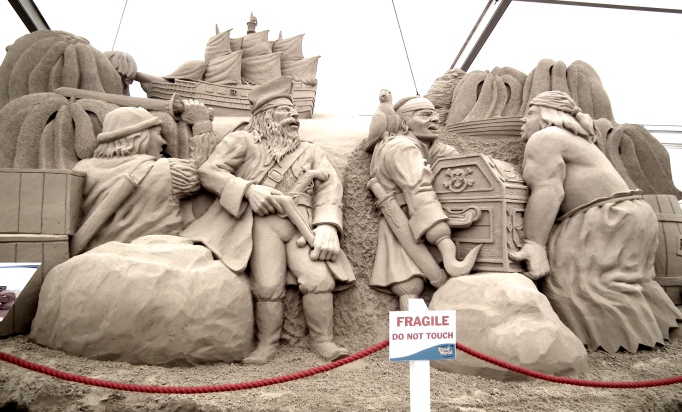
For many years there has been a tradition of sand sculpture on Weymouth beach and now, a new and permanent sand sculpture exhibition has opened near the sea life centre. Artists from round the world were invited to do their stuff and here is a simple of their work.
![]()
![]()
![]()
We discovered a place a few days ago that even most local people have never heard of. Wolfeton House, just outside Dorchester is a gem. Dating from the thirteen hundreds this lovely old house at the end of a rutted track running through water meadows is home to Captain & Mrs Thimbleby. We were shown around the ancient rooms by the captain and his elderly lady guide. Nothing has been “tarted up” in this atmospheric building; dust and cobwebs just add to the charm and the private areas of the rooms are cordoned of with binder twine looped over chair backs. I spent much of the visit talking with Nigel Thimbleby, a charming man, and he proudly showed us the results of his refurbishment work. This simply meant ripping out “improvements” in order to reveal the original fabric. If you ever visit, the recently revealed original oak floor in the great hall is a show stopper.
![]()
In 1594 the left hand tower of the gatehouse pictured above was used to imprison a catholic priest named Cornelius. He refused to renounce his faith and was taken to Dorchester, tried and hung, drawn and quartered. He haunts the stairs that lead up to his cell. I don’t blame him, it probably hurt like hell!


The anchor in the churchyard is from the Avalanche and the stained glass windows in the church depict streams of bubbles – large bubbles for drowned adults and small bubbles for the children.
They have pollarded the trees outside the caravan allowing us a free view to the top of Jordan Hill. One particular pigeon has adopted this newly formed platform as his favourite perch. I snapped him as he looked distinctly puzzled at the strange bird close by.

And while Mr.Pidge wasn't looking, a handsome green woodpecker - or "yaffle" - nicked his spot.

For many years there has been a tradition of sand sculpture on Weymouth beach and now, a new and permanent sand sculpture exhibition has opened near the sea life centre. Artists from round the world were invited to do their stuff and here is a simple of their work.


We discovered a place a few days ago that even most local people have never heard of. Wolfeton House, just outside Dorchester is a gem. Dating from the thirteen hundreds this lovely old house at the end of a rutted track running through water meadows is home to Captain & Mrs Thimbleby. We were shown around the ancient rooms by the captain and his elderly lady guide. Nothing has been “tarted up” in this atmospheric building; dust and cobwebs just add to the charm and the private areas of the rooms are cordoned of with binder twine looped over chair backs. I spent much of the visit talking with Nigel Thimbleby, a charming man, and he proudly showed us the results of his refurbishment work. This simply meant ripping out “improvements” in order to reveal the original fabric. If you ever visit, the recently revealed original oak floor in the great hall is a show stopper.

In 1594 the left hand tower of the gatehouse pictured above was used to imprison a catholic priest named Cornelius. He refused to renounce his faith and was taken to Dorchester, tried and hung, drawn and quartered. He haunts the stairs that lead up to his cell. I don’t blame him, it probably hurt like hell!
Saturday, 14 May 2011
140511
Our long relationship with malfunctioning electrical equipment continues. Had to call out the bloke today to attend a sickly fridge freezer. He left here scratching his head and without a fix for our poor old “whitegood”. He may come back, he may not – who knows. In the meantime we will have to put up with a fridge compartment that thinks it’s a freezer. At least the eggs don’t break if you drop’em.
Used the mega zoom on the latest camera to get this shot out in Weymouth Bay of a yacht race. Note the rescue boat in the background :-)……… another example of health and safety overkill?

Used the mega zoom on the latest camera to get this shot out in Weymouth Bay of a yacht race. Note the rescue boat in the background :-)……… another example of health and safety overkill?

Subscribe to:
Posts (Atom)